Suzanne Dyer
Phone
(310) 528-7480
Email
[email protected]

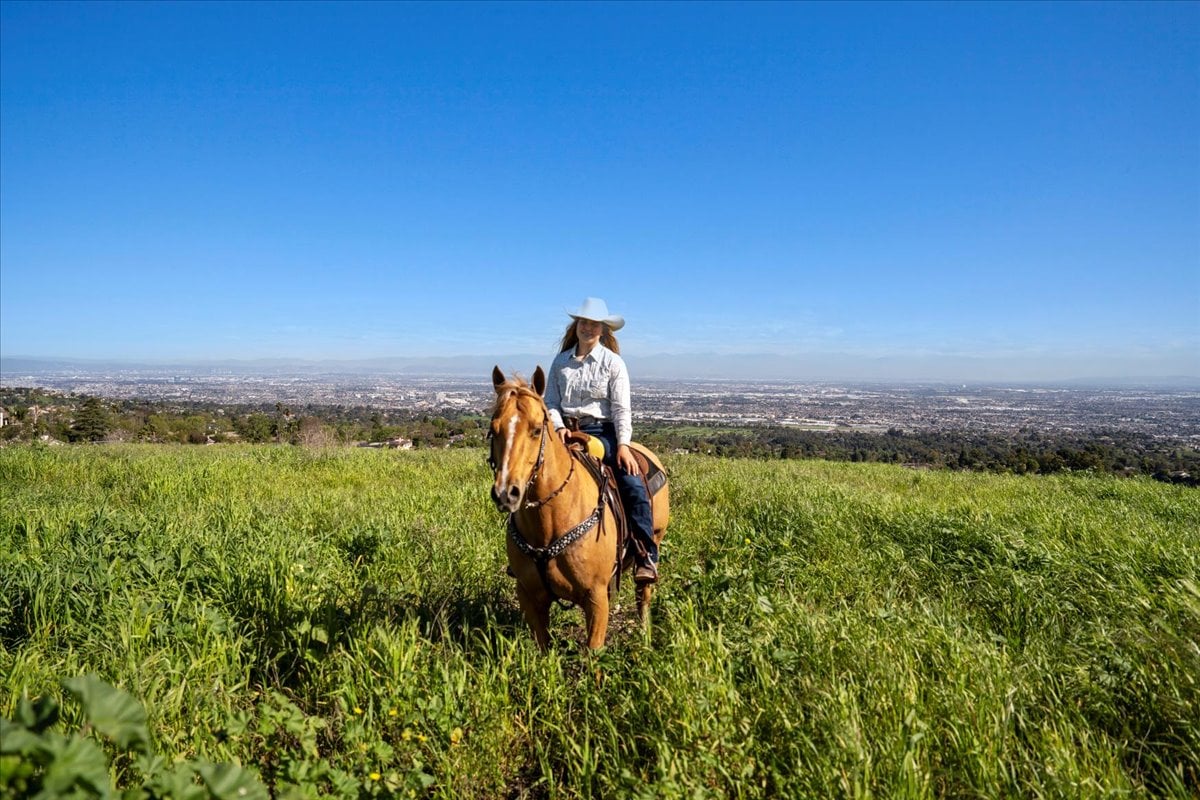
Buying a horse property in Palos Verdes is very different from buying a conventional home.
A property can look beautiful online and still fail to work for a serious horse owner.
That is because equestrian buyers are evaluating two properties at once:
the house and the horse setup.
They are looking at the barn, turnout, land, trailer access, trails, drainage, privacy and how the entire property functions day to day.
After decades of selling real estate throughout Palos Verdes, and as a horse owner myself, I have found that the properties equestrian buyers respond to most strongly are not always the ones with the largest acreage or the fanciest barn.
They are the properties that simply work well for horses and people together.
A good equestrian property usually combines several things:
The key word is usable.
A two-acre parcel dominated by steep slope may be less functional than a smaller property with flat land, good access and a well-designed horse setup.
That is why acreage alone does not determine value.
One of the first things experienced horse buyers notice is how the land actually functions.
They are thinking about questions such as:
A large lot can sound impressive in a listing description.
But equestrian buyers care much more about how much of that lot they can realistically use.
Trailer access is one of the most overlooked aspects of horse-property real estate.
A beautiful barn is much less useful if a truck and trailer cannot comfortably reach it.
Horse owners often evaluate:
This is something an automated valuation system cannot see.
But to a horse buyer, it can materially affect the desirability of the property.
A barn does not automatically add significant value simply because it exists.
Buyers want to know whether it is functional.
They may look at:
A smaller, well-designed barn can sometimes be more appealing than a larger facility that is difficult to use.
Most horse owners care deeply about turnout.
They want to know whether their horses have safe, practical space outside the stalls.
That may include:
The configuration matters almost as much as the amount of space.
Buyers may also consider fencing quality, shade and how easily horses can be moved between stalls and turnout areas.
One of the most special aspects of equestrian living on the Palos Verdes Peninsula is the trail system.
In areas such as Rolling Hills and Rolling Hills Estates, buyers may be able to ride directly from their property into an established network of equestrian trails.
For many riders, this is enormously valuable.
The ability to saddle a horse and ride from home rather than loading into a trailer every time can completely change the lifestyle.
That is why trail proximity and access should be clearly explained when marketing an equestrian property.
Dapplegray Lanes in Rolling Hills Estates is one of the Peninsula’s best-known horse-property neighborhoods.
It offers something unusual in Los Angeles County: the ability to keep horses at home while remaining close to schools, shopping and everyday conveniences.
The neighborhood’s equestrian character, trails and nearby riding facilities create a lifestyle that appeals to buyers who want horses without giving up South Bay accessibility.
But even within Dapplegray Lanes, properties can vary dramatically.
A buyer should compare:
Those differences can have a significant impact on market value.
Rolling Hills offers another version of the Palos Verdes equestrian lifestyle.
Behind the gates, buyers may find larger acreage, more privacy and a rural atmosphere that feels remarkably removed from Los Angeles.
Rolling Hills buyers often pay close attention to:
For some buyers, Rolling Hills is the ideal.
For others, the accessibility and neighborhood feel of Rolling Hills Estates or Dapplegray Lanes may be a better fit.
There is no single “best” horse community.
The right choice depends on how the buyer actually lives with their horses.
Horse buyers are not only buying barns and land.
They still want a home they enjoy living in.
A successful equestrian property balances:
horse functionality + residential lifestyle
Buyers may pay premiums for:
The strongest properties make neither the horses nor the people feel like an afterthought.
This is where seller strategy becomes important.
A horse property may generate interest but fail to produce an offer because of:
The important thing is to understand which objection keeps repeating.
If several buyers say they love the property but cannot make the horse setup work, more advertising will not solve the problem.
If buyers love the property and horse facilities but consistently say the monthly payment is too high, that may be a pricing or financing issue.
Good marketing creates exposure.
Experienced representation interprets what buyers do after they see the property.
Traditional comparable sales do not always tell the whole story.
Two homes can be similar in size but completely different as equestrian properties.
One may have:
Another may have a larger house but none of those features.
To a horse buyer, those differences can be worth a great deal.
That is why I evaluate both the residential value and the equestrian value.
Before buying an equestrian property, I recommend asking:
These questions can be just as important as the roof age or kitchen remodel.
If you are selling horse property, ask:
A property should not be marketed simply as “horse property.”
The marketing should explain why it works for horses.
The best equestrian properties are not necessarily the biggest.
They are the ones where everything works together.
The house works.
The land works.
The barn works.
The trailer gets in and out.
The horses have turnout.
The rider can access the trails.
And the property still feels like a beautiful place to live.
That is what serious equestrian buyers recognize.
And it is why horse property should be evaluated and marketed differently from a conventional home.
If you are searching in Rolling Hills, Rolling Hills Estates, Dapplegray Lanes or elsewhere on the Palos Verdes Peninsula, I can help you evaluate both the home and the equestrian setup.
Some opportunities may also be available privately or off market.
I am happy to provide a confidential home valuation of both the residential and equestrian value of your property.
Click here "Horse Guide" for my free guide on Palos Verdes Horse Property.
Suzanne Dyer
Strand Hill | Forbes Global Properties
Palos Verdes & South Bay Real Estate
310-528-7480
SuzanneDyer.com
If you´re listing or selling real estate in the Palos Verdes Peninsula and surrounding areas, put a winning real estate professional to work for you.
Let's Connect